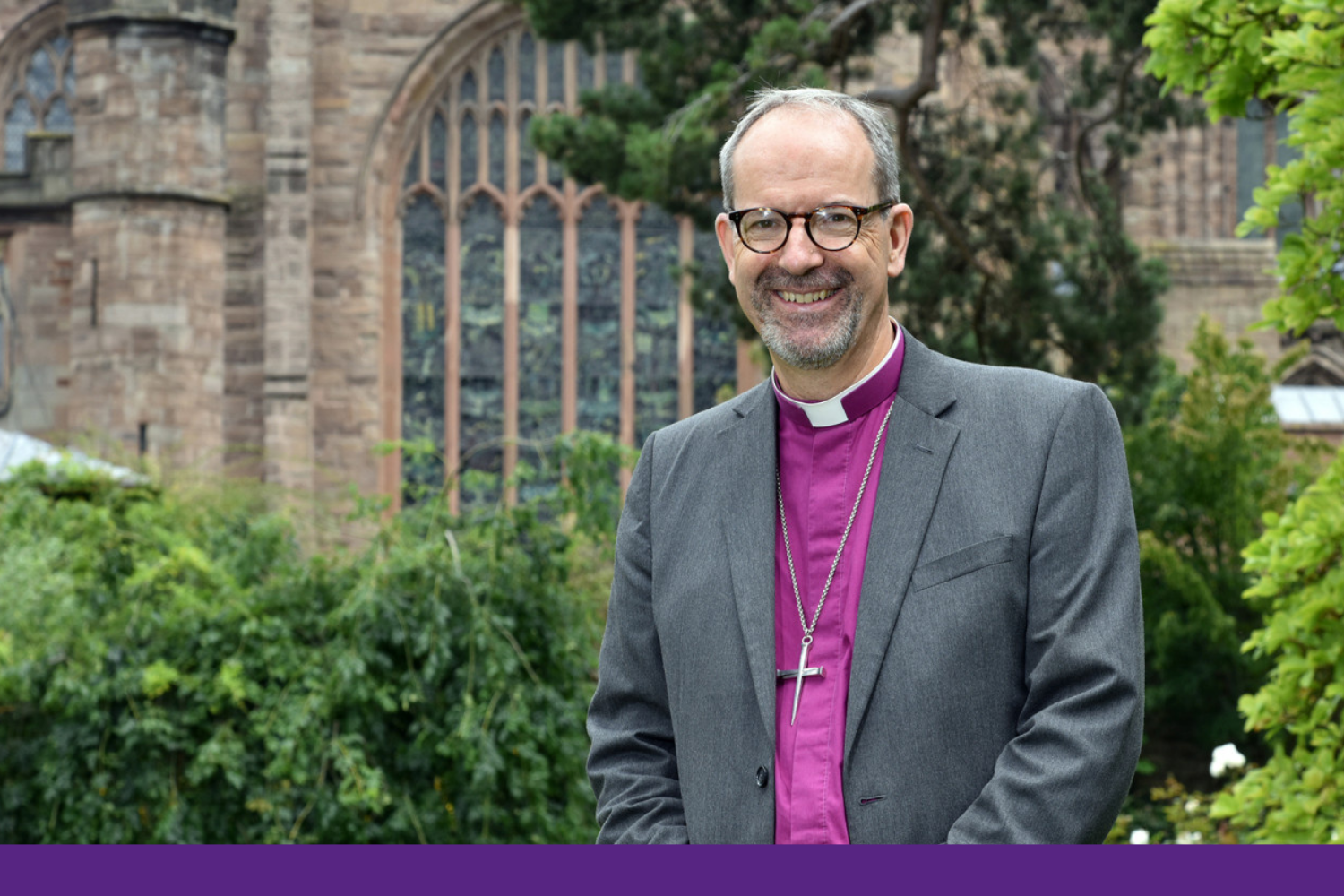

Bishop Richard’s Weekly Video Message and Transcript for 29.10.2026
This week Bishop Richard reflects on the ups and downs of a busy life and the importance of seeing the bigger picture in the everyday.

This week Bishop Richard reflects on the special qualities of small, rural parishes.
Hello everyone and welcome to this week’s video.
I’m recording this week from the Love Rural conference, a gathering of rural church ministers and pioneers from around the country. It’s quite inspiring to see how many ideas are bearing fruit in the most unexpected places. I sense the institutional Church of England doesn’t quite know what to do with the rural church. Even though two-thirds of Anglicans nationally are probably in a rural church on Sunday morning, there remains the draw to the urban and the large, particularly in funding (or so it feels).
Jesus wasn’t overawed by manifestations of power. He sought to undermine and subvert most power structures religious or political. In his parables it was often the small and insignificant things that were transformative. It was the yeast in the dough, the salt in the recipe and the first would be last and last would be first. The sermon on the mount is full of counter intuitive descriptions of who would be blessed in the kingdom. It was the poor, the meek and persecuted rather than the rich, the confident and secure.
A snippet of a parable that sums this up is Luke 13: 18, the parable of the mustard seed. The smallest of seeds grows into a plant large enough for the birds to seek shelter. The plant he probably had in mind was black mustard, Brassica Negra. An annual plant with seeds the size of oilseed rape, which over a growing season could reach 2-3 metres in height, sufficiently dense for birds to nest in securely. Even this parable was subversive of conventional wisdom at the time. The images of a kingdom that could shelter the birds in the Old Testament was that of a mighty cedar, rather like the ones in the Palace garden.
The point was that the Kingdom of God – Gods reign in human experience grew in the most unexpected of places. Something seemingly insignificant like a mustard seed could indeed become something substantial. Congregations in our diocese are largely small and scattered. In the eyes of the wider community and even the national church they can be regarded as insignificant, but the values of the kingdom are different. A small church is not a failed large church. It is a community in which Jesus can just as easily be made known, in which disciples can be formed and which can act as a catalyst for community transformation. So can I make a plea that when I come around the diocese Sunday by Sunday. Please don’t apologise if there aren’t many people there. All our churches and congregations are precious to God and they are precious to me whether there are 20 or 200. Jesus makes it clear that much of the real spiritual work can be hidden. Large size doesn’t imply a blessing; small size doesn’t imply God has abandoned us.
In the parable the important thing about the plant is that it provides shelter for the birds. Several of our clergy have done sabbatical research on what makes for a thriving rural church. One of the most consistent themes is hospitality. So many of our churches are keen to see their buildings as a community resource with loos, kitchens and use by other groups. The bread and butter work of baptisms, marriage and funerals provide an opportunity to welcome people at times of joy and sadness. I’ve lost count of the number of people over the course of 32 years of ministry who have been surprised that local church could be some genuinely welcome and hospitable even when they had had little contact with the church before. Such hospitality may well bear unseen fruit, not necessarily immediately but in the future. A repeated themes in the testimonials of confirmation candidates is the welcome and support they received on their spiritual journey from the little, the local and the ordinary. None of these things are expensive. All are things that any church community can do. Some of the most heart-warming stories of growth in our diocese are of hospitality that the wider society struggles to welcome and include: those with special educational needs, the disabled and those who struggle financially or with behavioural issues. These will not necessarily be reflected in statistics and they certainly won’t make a big difference to parish finances. In a bid process they won’t fit the criteria for long term sustainability. But they are signs of the kingdom. They are precisely what Jesus had in mind in the parable.
So don’t be anxious or embarrassed about the small. As the writer to the Hebrews said in chapter 13:2. “Do not forget to show hospitality to strangers, for by so doing some people have shown hospitality to angels without knowing it!
ENDS
This week Bishop Richard reflects on the ups and downs of a busy life and the importance of seeing the bigger picture in the everyday.
In this week's video, the Bishop reflects on the financial and organisational challenges impacting the diocese and the Church more widely.
In this week’s video, the Bishop reflects on the Archbishop of Canterbury’s visit, celebrates the many ministries across the Diocese, and looks ahead to a season of renewal as we build on the legacy of our 1350th anniversary year.
In this week’s video from Tanzania, the Bishop reflects on what we can learn from the joy, faith and hope of the growing Church there.
In this week’s video from Tanzania, the Bishop reflects on leadership, humility and the importance of showing grace when people make mistakes.
Video for 24th September, 2026 Hello everyone and welcome to this week’s video. As I record this, I’m glad for…
Video for September 17th, 2026 Hello everyone and welcome to this week’s video. Last week, I was on one of…
Video for September 10th, 2026 Hello everyone and welcome to this week’s video. There is very little more stressful than…
Video for September 3rd, 2026

Rev’d up and ready to go – Bishop Richard’s 24-7 Prayer Pilgrimage As part of the 24/7 prayer movement’s Global…